Nr. on the small map: 2 (Kleinheubach)
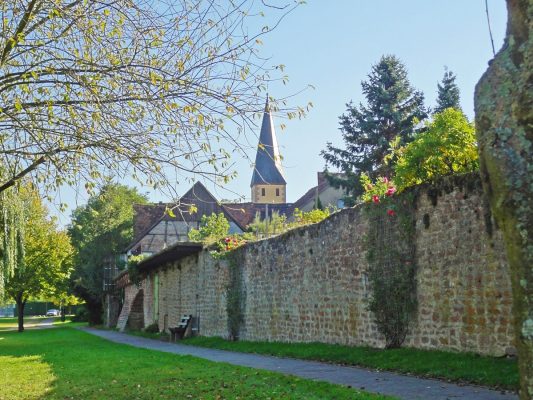
The area around St. Martin was the origin of Kleinheubach, because this fortified church was located close to the Main-River on higher ground and therefore not endangered by floods. The former enclosing wall is stunning but was only retained at the riverside; inside the church yard you can find some one-room storages. A smaller predecessing building, was built in 1455. Of this church the tower and a dedicatory Latin inscription with translation have been maintained. Three remarkable gothic murals at the entrance originate from the same era:
St. Martin with the beggar, St. Wendelin as a shepherd, each with a church illustration, symbols, and names of the four evangelists, the Veil of Veronica, and inside, the archangel Michael depicted with scales, weighing souls.
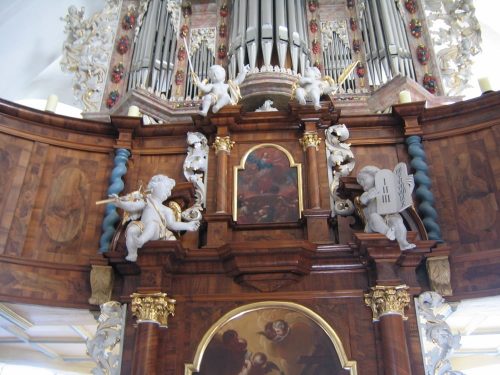
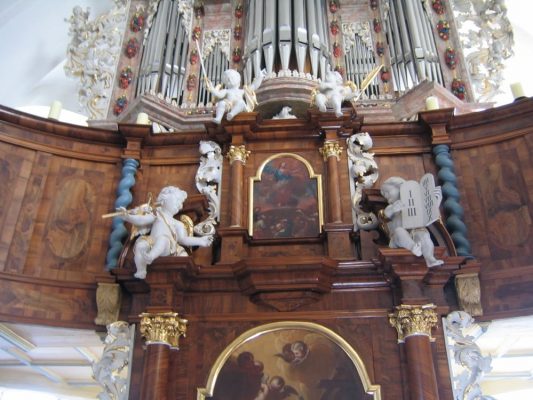
The Hercules spolia had once been part of the foundation of a Roman Jupiter-Giant-Pillar as the Castellum “Old Town” was not far away. The nave and both circular towers were being constructed between 1707 and 1710. In the chancel you see the altar with a nativity painting, above there is a balustrade with the organ and beside there is the pulpit in its unmodified condition. The organ builder Johann Christian Dauphin (1682-1730), who had newly arrived from Thuringia, built the organ in 1710, which was reconstructed in the baroque style in 2010. “Crowns of Death”, which were placed on caskets of unmarried people as part of a burial custom, are on display. Next to the entrance of the church yard, inside the church, and in the small garden behind, you find seven grave slabs originating from the 17th and 18th century five of which were once embedded in the church floor.
Opening hours:
May to October 09.00 am to 06.00 pm,
November to April on demand at the rectory, Tel. +49(0)9371-4248