Signal fires in the Odenwald – The “signal fir” of Wenschdorf-Reichartshausen
The highest mountains in the Odenwald used to be connected by a network of signal stations, which made it possible to transmit important messages from one end of the mountain range to the other in a short time and to warn the population of enemies in times of trouble.
The “signal fir” of Wenschdorf-Reichartshausen was established around the time of the Thirty Years’ War and was maintained until 1800. In Wenschdorf, however, it was a pine tree that served as the signal fir. Two iron rings were attached to the top of the tree, from which a bucket of burning pitch could be pulled up with a rope when needed. The upper ring was probably used to attach the torch. The rising smoke or visible fire was an alarm signal that could be seen from afar by the inhabitants of distant villages, especially when there was a threat of war. Warned in good time, the men able to bear arms could gather at assembly points. This warning system also gave the inhabitants time to hide in the woods.
There is no evidence as to whether these signal firs already existed in Roman times and were used for the rapid transmission of news from the guard stations on the Odenwald Limes to the hinterland on the Rhine.
From the planting site, there used to be a far-reaching view down to Miltenberg and on to Bürgstadt in the north and Amorbach in the south. Remains of the watchtowers on the Main-Limes can still be seen in the area. Until the 1980s, a 300-year-old, 14-metre-high and 2-metre-thick pine tree stood here, which eventually collapsed due to rot. Both iron rings of the Wenschdorf signal fir were then unfortunately lost due to ignorance about their purpose.
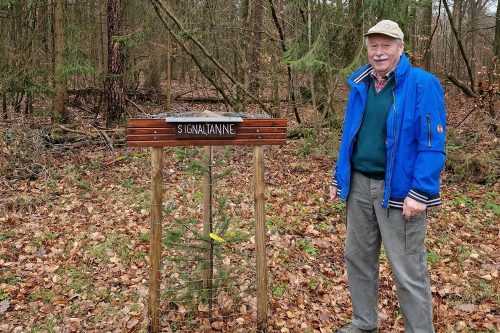
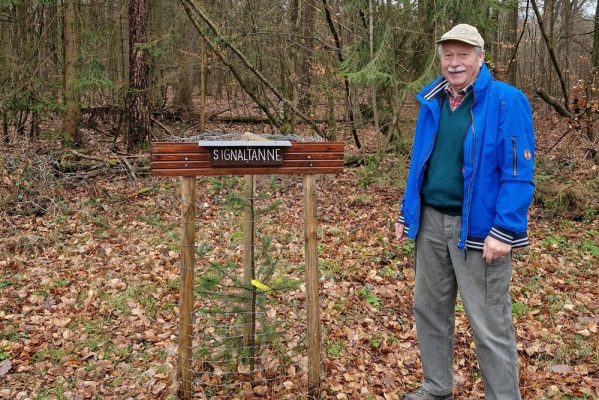
In the past, new signal firs have repeatedly been planted here to commemorate this historical practice. Unfortunately, all the plantings fell victim to wind breakage, snow breakage or drought. In March 2023, on the initiative of Herrmann Farrenkopf, a Douglas fir was planted at Reichartshausener Höhe by the town of Miltenberg, which will hopefully withstand the climatic conditions.