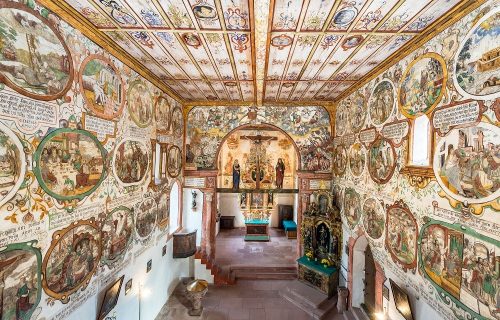
It is the older one of two churches in Bürgstadt, that are just a stone’s throw away from each other. This may be the reason why the older one was called a “chapel” to make them easier to distinguish. In the Middle Ages they both were churches of two different local lords. The Martinskapelle may date back to the late Merovingian period and its surroundings, the Martinsgasse, is considered the town’s basic cell. According to radio carbon dating, the “chapel” was built in stone on the ruins of a burnt-down predecessor, probably made of wood, around the year 950.
Burnt down in the 13th century it remained a ruin for several years. In the late 14th century the citizens accepted responsibility for the chapel’s ruin with all rights and obligations. They reconstructed it to be used for “Early Masses”, thereby giving it another right to exist side by side with the parish church, which was used as the “mother church” for the surrounding towns, including Miltenberg.
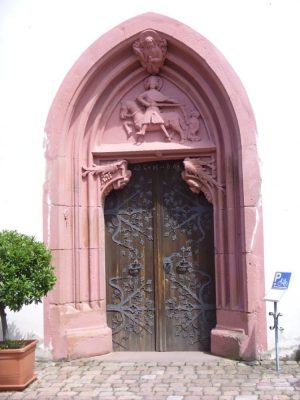
Around 1490 the Martinskapelle received its late Gothic porch and the impressive crucifixion group in the chancel. Due to the German Peasants’ War and the Protestant Reformation the building fell into decay. After the Council of Trent the Counter-Reformation took hold of Bürgstadt and steeple of the parish church was heightened in 1585. In this time the priest Balthasar Häffner and the mayor Peter Schneider planned another counter-reformatory piece of work: A biblia pauperum, a “paupers’ bible” should be added to the Martinskapelle, to give the faithful a better understanding of the salvific history in 40 murals. To this end the number of Gothic windows in the nave was reduced and replaced with smaller Romanesque windows. Andreas Herneisen, a painter from Nuremberg started painting the murals (ceiling and chancel) but did not finish the work. After the new town hall had been built (1590-93), an unknown artist finished the 40 famous tableaux and the mysterious “Judgement Day” in the quire arch in 1593. For art historians the paintings’ complete state of preservation is of interregional importance.
The entrance fee is 2 € per person. You can make use of the audio guide (available in German, English or French; duration ca. 18 minutes)
Tip: If you want to visit the chapel on your own, you can borrow the key from the plant nursery Kling next door or from the bistro Nadjas (Hauptstraße 2, just around the corner, opposite the historic town hall). A key can also be borrowed from family Schlegel-Schulz who live just opposite the chapel. All of these places will ask for a donation to preserve the chapel. An audio recording with information on the Martinskapelle can be played for 2 €.
Links to our partners:
Gäste-Info Bürgstadt e.V.
Heimat- und Geschichtsverein Bürgstadt e.V.